
High Resolution Neutron Spectrometer
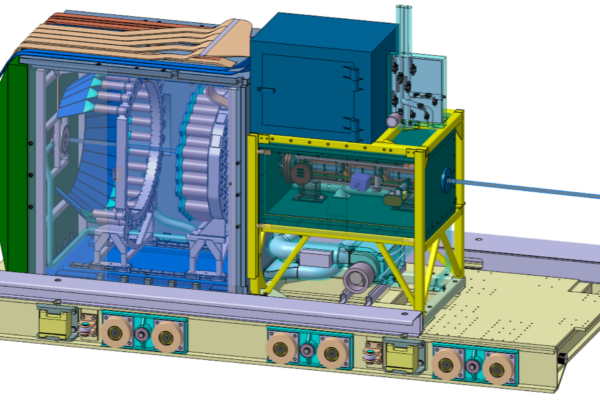
The High Resolution Neutron Spectrometer (HRNS), a diagnostic for international thermonuclear fusion reactor ITER, is being developed by scientific partners University of Uppsala (Sweden), IFJ-PAN (Poland), CNR-ISTP (Italy). This system is a combination of 4 spectrometers of three types that cover a fusion power range of 0.5MW to 500MW for the detection of the fuel ion ratio (ratio between tritium and deuterium), an important burning plasma control parameter.
Fagerström, our Swedish partner, was asked by the University of Uppsala to manage the overall engineering of HRNS, and details of the Swedish contribution: the Time-of-Flight (ToF) spectrometers. These particle detectors operate alongside with the Thin-foil Proton Recoil (TPR) spectrometer and the Neutron Diamon Detector (NDD). The HRNS system is housed on a movable skid in ITER equatorial port cell #01.
Challenges: lead the engineering team and integrate the scientific partners to cooperate efficiently. Engineer the system to have the detectors, cabling, neutron shielding, thermal conditioning, magnetic shielding into the limited volume and mass budget, alongside with ensuring alignment during installation and operational conditions, complying with constraints on activation, electronics exposure, reliability requirements – for example, the inherent reliability of the system should be > 99.9991% for the fuel ion ratio to a 1-sigma accuracy of 20% over the defined power range.
Solution: Simplify and parellelize the system where possible, for example to move electronics as far away of the radiated areas as possible, whilst not impacting performance.
Role of HiT: supply engineering project lead able to liaise in the ITER diagnostics context to manage interfaces and data attribution into ITER systems